QtMultiDictTagEditor#
Edit multiple named dictionaries together with an aggregate summary view.
Screenshot#
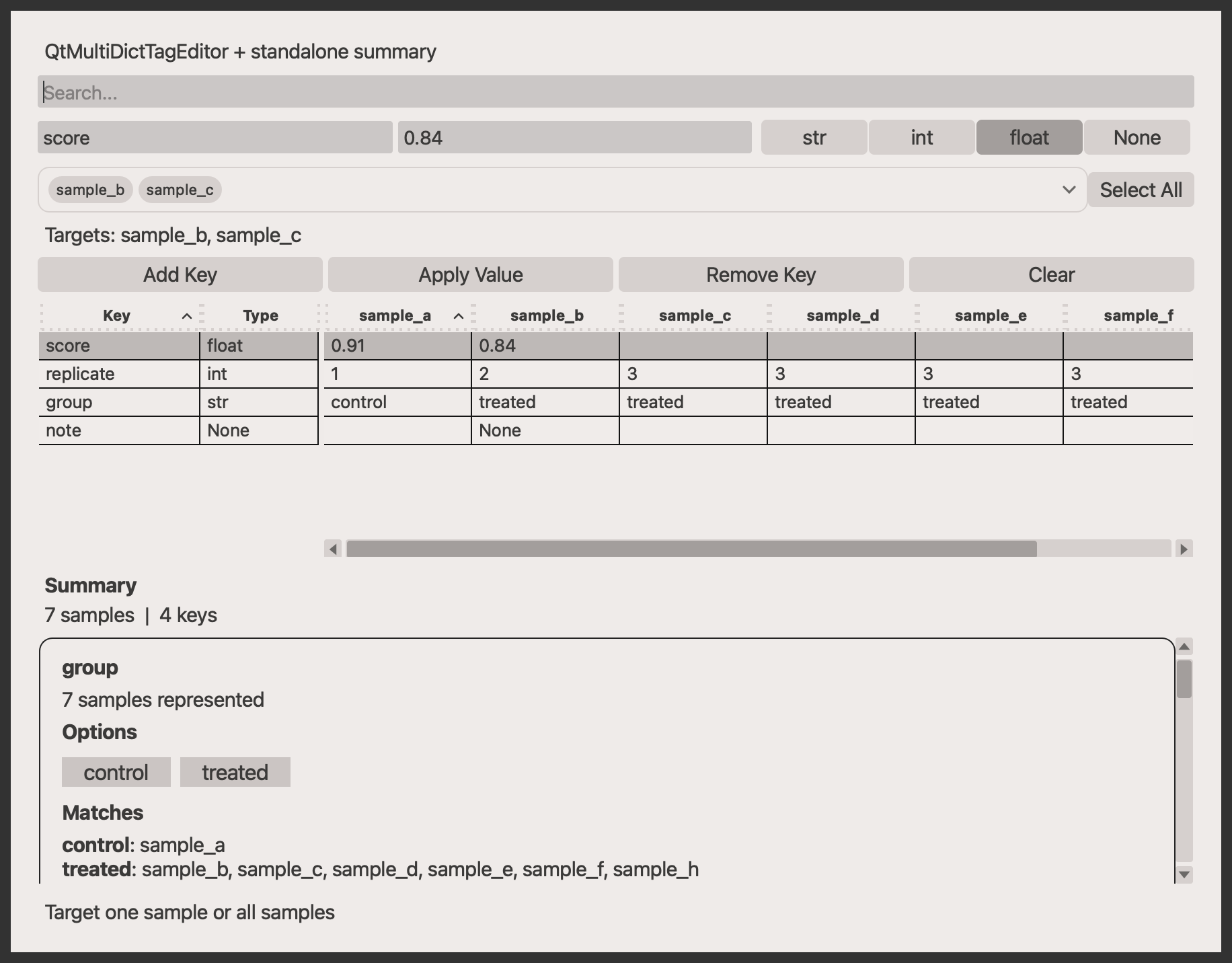
Example#
Source: examples/qt_multi_dict_tag_editor.py
"""QtMultiDictTagEditor."""

from qtpy.QtWidgets import QApplication, QLabel, QVBoxLayout, QWidget

from qtextra.config import THEMES
from qtextra.widgets.qt_multi_dict_summary import QtMultiDictSummaryWidget
from qtextra.widgets.qt_multi_dict_tag_editor import QtMultiDictTagEditor

app = QApplication([])

widget = QWidget()
THEMES.apply(widget)

layout = QVBoxLayout(widget)

layout.addWidget(QLabel("QtMultiDictTagEditor + standalone summary"))
editor = QtMultiDictTagEditor()
summary = QtMultiDictSummaryWidget()
editor.evt_items_changed.connect(summary.set_items)
editor.set_items(
    {
        "sample_a": {
            "group": "control",
            "replicate": 1,
            "score": 0.91,
        },
        "sample_b": {
            "group": "treated",
            "replicate": 2,
            "score": 0.84,
            "note": None,
        },
        "sample_c": {
            "group": "treated",
            "replicate": 3,
        },
        "sample_d": {
            "group": "treated",
            "replicate": 3,
        },
        "sample_e": {
            "group": "treated",
            "replicate": 3,
        },
        "sample_f": {
            "group": "treated",
            "replicate": 3,
        },
        "sample_h": {
            "group": "treated",
            "replicate": 3,
        },
    },
)
body = QVBoxLayout()
body.addWidget(editor, stretch=1)
body.addWidget(summary, stretch=3)
layout.addLayout(body)

layout.addWidget(QLabel("Target one sample or all samples"))
editor.set_target_samples(["sample_b", "sample_c"])
editor.table.selectRow(0)

widget.resize(900, 700)
widget.show()

app.exec_()
Notes#
- Useful when multiple samples or records share similar metadata fields.
API#
Qt Class#
Signals#
evt_key_added#
evt_key_removed#
evt_search_changed#
evt_items_changed#
evt_value_changed#
evt_target_changed#
Methods#
Editor for managing multiple dictionaries side by side.
addCurrentKey = add_current_key
class-attribute
instance-attribute
#
addKey = add_key
class-attribute
instance-attribute
#
applyCurrentValue = apply_current_value
class-attribute
instance-attribute
#
clearItems = clear_items
class-attribute
instance-attribute
#
confirmClearItems = confirm_clear_items
class-attribute
instance-attribute
#
exportDicts = export_dicts
class-attribute
instance-attribute
#
getItems = items
class-attribute
instance-attribute
#
getSampleNames = sample_names
class-attribute
instance-attribute
#
getTargetSamples = current_target_samples
class-attribute
instance-attribute
#
getValue = get_value
class-attribute
instance-attribute
#
removeKey = remove_key
class-attribute
instance-attribute
#
removeSelectedKey = remove_selected_key
class-attribute
instance-attribute
#
setCurrentValueType = set_current_value_type
class-attribute
instance-attribute
#
setItems = set_items
class-attribute
instance-attribute
#
setSamples = set_samples
class-attribute
instance-attribute
#
setTargetSamples = set_target_samples
class-attribute
instance-attribute
#
setValue = set_value
class-attribute
instance-attribute
#
add_current_key() -> bool
#
Add the current key to the selected target.
add_key(key: str, value: DictTagValue = None, *, target_sample: str | None = None, target_samples: list[str] | None = None, value_type: str | None = None) -> bool
#
Add a key to one sample or all samples.
apply_current_value() -> bool
#
Apply the current value to the selected target for the current key.
clear_items(emit_signal: bool = True) -> None
#
Remove all keys from all samples.
confirm_clear_items() -> bool
#
Ask for confirmation before clearing all keys.
current_target_sample() -> str | None
#
Return the current target sample when exactly one sample is selected.
current_target_samples() -> list[str]
#
Return the currently selected target samples.
current_value_type() -> str
#
Return the currently selected value type.
export_dicts() -> dict[str, dict[str, DictTagValue]]
#
Export the current nested dictionaries.
get_value(key: str, sample: str) -> DictTagValue
#
Return the typed value for a key in a sample.
items() -> dict[str, dict[str, DictTagValue]]
#
Return the current sample dictionaries.
remove_key(key: str) -> bool
#
Remove a key from all samples.
remove_selected_key() -> bool
#
Remove the selected key row.
sample_names() -> list[str]
#
Return the configured sample names.
select_all_samples() -> None
#
Select every configured sample in the target picker.
set_current_value_type(value_type: str) -> None
#
Set the current value type and refresh validation.
set_items(items: Mapping[str, Mapping[str, DictTagValue]]) -> None
#
Replace all sample dictionaries.
set_samples(samples: list[str]) -> None
#
Set the active sample names.
set_target_samples(samples: list[str]) -> None
#
Set the selected target samples.
set_value(key: str, value: DictTagValue, *, target_sample: str | None = None, target_samples: list[str] | None = None, value_type: str | None = None) -> bool
#
Set a value for a key in one sample or all samples.
Qt Class#
Methods#
Summary panel for nested dictionary data.
clearItems = clear_items
class-attribute
instance-attribute
#
setItems = set_items
class-attribute
instance-attribute
#
summaryData = summary_data
class-attribute
instance-attribute
#
build_summary(items: Mapping[str, Mapping[str, DictTagValue]]) -> dict
classmethod
#
Build structured summary data for nested dictionaries.
clear_items() -> None
#
Clear all summaries.
set_items(items: Mapping[str, Mapping[str, DictTagValue]]) -> None
#
Compute summaries from nested dictionaries.
summary_data() -> dict
#
Return the computed summary structure.